The Bahá’í Temple in Wilmette, Illinois: A Black and White Meditation on Sacred Architecture
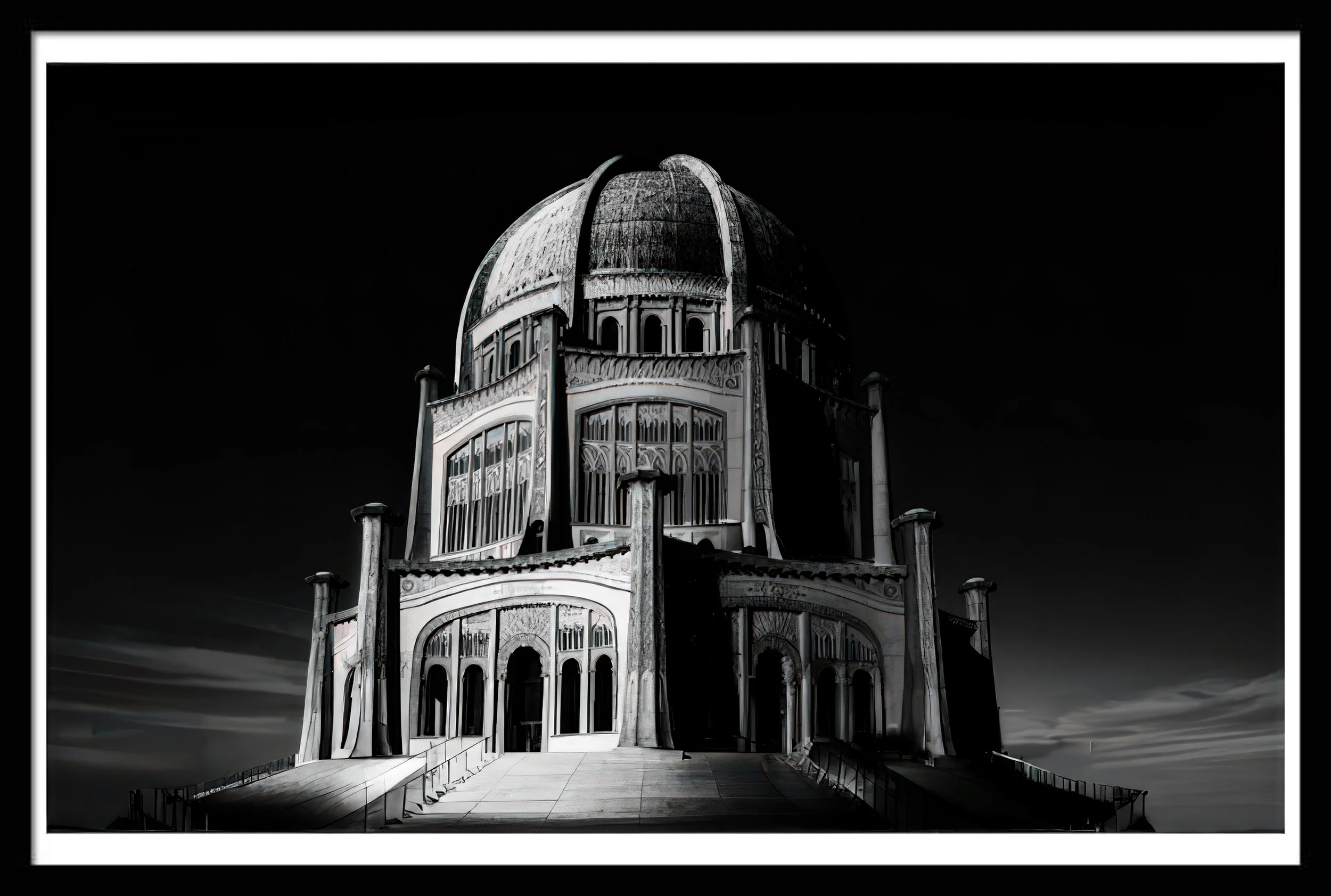
The Baha’i Temple in Wilmette Illinois
The Bahá’í House of Worship is one of the most striking examples of sacred architecture in North America. Located just north of Chicago along the shores of Lake Michigan, the Bahá’í Temple in Wilmette is known for its intricate design, symbolic geometry, and message of unity.
While the temple is often photographed in daylight, its true architectural power emerges at night — when light and shadow reduce the structure to form, rhythm, and meaning. In black and white, the temple becomes timeless, less a landmark and more a meditation.
Sacred Architecture Beyond Religion
The Bahá’í Temple is open to people of all faiths and backgrounds. Its design reflects core principles of the Bahá’í Faith: unity, balance, and harmony among religions and cultures. The building’s nine sides — each with its own entrance — symbolize inclusiveness and the many paths that lead toward spiritual understanding.
In monochrome photography, these ideas are expressed visually rather than symbolically. Without color, the eye is drawn to geometry, proportion, and repetition. Arches rise with purpose. Columns stand in quiet symmetry. The dome becomes a point of convergence — not ornamental, but inevitable.
Why the Bahá’í Temple Works in Black and White Photography
Black and white architectural photography strips a subject down to essentials. In the case of the Bahá’í Temple, this reduction enhances its spiritual presence.
At night, selective illumination reveals just enough detail to suggest complexity while allowing large portions of the structure to dissolve into shadow. The effect is contemplative rather than dramatic. The temple does not compete for attention — it commands stillness.
This approach transforms the building from a recognizable location into an abstract expression of sacred space. The result is an image that feels universal, not regional; symbolic, not descriptive.
A Chicago-Area Landmark with Global Meaning
Although located in Wilmette, Illinois, the Bahá’í House of Worship holds international significance. It is the only continental Bahá’í temple in North America and one of only a small number worldwide. Its construction began in the early 20th century and took more than four decades to complete — a testament to patience, craftsmanship, and collective vision.
Seen through a fine-art photographic lens, the temple becomes less about history and more about presence. It is architecture that slows the viewer down, invites reflection, and rewards careful looking.
Fine Art Architectural Photography as Interpretation
This image is not intended as documentation. It is an interpretation.
By emphasizing contrast, shadow, and form, the photograph distills the Bahá’í Temple into a visual statement about silence, balance, and transcendence. The surrounding darkness is not absence — it is space. It allows the architecture to breathe, to exist without distraction.
In this way, the photograph mirrors the purpose of the building itself: not to instruct, but to invite.
The Enduring Power of Sacred Design
Great sacred architecture does not rely on belief to be effective. It relies on proportion, light, and intention. The Bahá’í Temple in Wilmette succeeds because it understands this truth.
In black and white, at night, the temple does not simply stand as a landmark.
It becomes an experience — one rooted in stillness, geometry, and quiet reverence.Sacred Architecture Beyond Religion
The Bahá’í Temple is open to people of all faiths and backgrounds. Its design reflects core principles of the Bahá’í Faith: unity, balance, and harmony among religions and cultures. The building’s nine sides — each with its own entrance — symbolize inclusiveness and the many paths that lead toward spiritual understanding.
In monochrome photography, these ideas are expressed visually rather than symbolically. Without color, the eye is drawn to geometry, proportion, and repetition. Arches rise with purpose. Columns stand in quiet symmetry. The dome becomes a point of convergence — not ornamental, but inevitable.
